Showing posts with label election reform. Show all posts

Thursday, August 25, 2011

Restored Democracy Should Be Our Focus


R.A. Monaco
August 25, 2011


Americans are being lured into distractions and caught up in partisan bickering while becoming increasingly disillusioned by congressional partisanship that has no foreseeable horizon. Every six and a half minutes another crisis fed headline booms across talk radio and 24 hour cable news programming enables, aids and abets, Congressional outlaws intent on accomplishing their stated purpose--not to fix things but to keep our president from fixing anything. The fact is that, as the country continues to regress as a democracy, most voters just don’t know which ball to keep their eye on.

Much has been said to criticize the vast right wing of our political system--deservingly so. However, right wing enlightenment, while not likely to occur, isn’t going to restore what is truly wrong with our political system. As a starting point, America needs to go back to their 7th grade civics studies, recall, understand and accept that our system of democracy was designed to limit the power of the president.

The endless criticisms of President Obama, that he is an appeasement-happy crypto-Republican, that he hasn’t tended to jobs quickly enough, that his administration’s healthcare plan is destined for the Supreme Court guillotine, or that the bankers on Wall Street are thriving once again while tens of millions of Americans are being crushed by the overhang of mortgage debt in an economy that predictably continues to fail, are all foreseeable issues of orchestrated design.

How long will it be before we hear that the President has been slow to act to the charge of a justice department investigation of Standard & Poors, who is thought to have purposely overrated toxic mortgage securities in the years before the bust? Surely, the next words we’ll hear from Wall Street drum beaters is that the investigation is a retaliatory decision that flows from the debt ceiling crisis credit downgrade—would the Tea Party mind?

President Obama’s strategic and structural challenges are immense but they are not solely the result of the radical right wing either. With the exception of continuing the Bush tax cuts, the president has needed 60 votes, not the customary 50, to address every major issue including stimulus, extending unemployment benefits and healthcare. Conservative Democrats have made the party’s majority an illusion while enabling insincere disruptive play-to-base regressive obstructionists. The bottom line for America is that the president lacks the power to overcome the congressional challenges set in place by a changed campaign finance election system that rewards obstinate representation and, in effect, has set functional limitations upon our democracy.

As early as 1905, President Theodore Roosevelt asserted the need for campaign finance reform and called for legislation to ban corporate contributions for political purposes. In response, the United States Congress enacted the Tillman Act of 1907, named for its sponsor Senator Benjamin Tillman, which banned corporate contributions.

In 1971, Congress consolidated its earlier reform efforts in the Federal Election Campaign Act of 1971 (FECA, Pub.L. 92-225, 86 Stat. 3, enacted February 7, 1972, 2 U.S.C. § 431 et seq.), instituting more stringent disclosure requirements for federal candidates, political parties and Political Action Committees (PACs).

More recently, in 2002, Congress made major revisions to the FECA in the Bipartisan Campaign Reform Act, more commonly referred to as "McCain-Feingold." However, in 2007 major portions of McCain-Feingold were struck down by the Supreme Court on Constitutional grounds in Wisconsin Right to Life v. Federal Election Commission , and again in 2008 in Davis v. Federal Election Commission .

However, in 2010 the Supreme Court gave new meaning to ATM machine politics by way of their Citizens United v. Federal Election Commission decision which struck down FECA's complete ban on corporate and union independent spending originally passed as part of the Taft-Hartley law in 1947.

Surely we can hope for, demand and attempt, to seek out better politicians and presidents. It’s time for Scotty to beam us all back up to reality. Our focus needs to be on realigning the interests of our elected representatives with that of the voters--not campaign contributors. Corporations don’t vote but their financial influence clearly has a hand around the throat of a functional democracy. We must refocus our priorities and first correct a campaign finance system that fosters an unworkable climate through the absence of transparency, financial accountability and the ATM machine politics that has put our democracy up for sale.


Monday, August 1, 2011

America's Report Card: "F"


By R.A. Monaco
August 1, 2011

Today, the real problems for our nation remain unemployment and a lack of aggregate demand. This is precisely the very same problem that presented 77 years ago during the Great Depression. Monetary policy now, as then, have reached its limits and further decline in interest rates realistically won't have much effect in stimulating the economy.

In order to restore our economy we are now left solely with the tool of fiscal policy to design a plan towards economic health and overcome what is surely to follow--increased unemployment and a contracting economy.

The fact is, that the initial stimulus package that was put into place to counter the full shock from the financial crisis, was far too inadequate and our newly elected president, failed to lead, ignoring the designs of his own commission's solutions, hovering outside the fray of debate. In the words of The New Yorker's Ryan Lizza, President Obama has pioneered a new style of statecraft: "Leading from behind."

Both democrats and republicans with the help of their over the top right wing extremists, have done a completely a inadequate job of explaining why a Keynesian solution would not be the best way to attack a Keynesian problem. Realistically, the explanation is that no solution was really being sought and partisan lines were being re-drawn. But, before we assign a grade to the list of failed assignments, some explanation about the principles of designing an effective stimulus program seem in order.

As an offer of authority, Joseph E. Stiglitz, winner of the Nobel Prize in economics points out that there is ample evidence to support that a Keynesian solution to our troubled economy can be found, not only in our own history of having to deal with precisely the same problem during the Great Depression, but most recently in China. In spite of facing significant shocks to its economy, China deployed one of the world's largest stimulus packages which resulted in one of the strongest documented economic recoveries.

Reflecting back to 2008, Americans must be asking themselves whether congress and the president was actually looking for a solution at all or just engaging in brinkmanship. As a practical matter, economic policies take months to be fully effective and money needs to get into the economy quickly. Clearly, George W. Bush's delay was costly, but President Obama could have hit the ground running and expedited implementation of his own plan instead of leaving this up to congressional debate and partisan compromise. That is, if in fact, he was seeking solutions instead of staying out of the fray of political debate to minimize political exposure while seeking to project an image of partisan compromise.

Standard Keynesian analysis seeks to maximize a multiplier that has an exponential return of government investment spending beyond the dollar's increase in national output. If the government spends money on a construction project, then the workers spend their pay to buy things, and others, in turn, spend their money. Every link in the chain boosts national income making the total increase in national income far greater than the initial amount spent by the government.

But not all spending has the same multipliers. Tax cuts for the rich, who save much of what they have, has a very low multiplier, just as does spending on foreign contractors working outside of the United States, Iraq for example, because the consumption takes place outside the country. On the other hand, increasing unemployment benefits has a high multiplier, because those who find themselves suddenly short of cash are going to spend almost every dollar they receive. Long run multipliers are even larger and policy makers needed to find ways to provide effective spending where benefits are realized two or three years from now too.

Stimulus spending to be effective needed to address the nation's long-term problems such as programs for the elderly, decaying infrastructure and global warming. But at the very least, policy makers should not have made them worse.

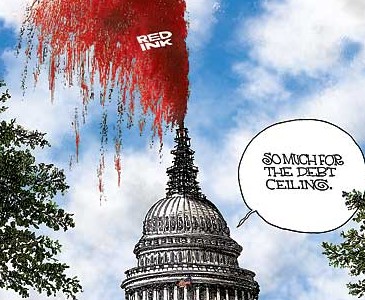
As a practical matter, it seems beyond reason, if not irresponsible, that for the entire duration of this manufactured debt ceiling crisis, discussions about the country's debt has never been in the context of balance sheet reality. It is a given that stimulus spending will inevitably increase a country's deficit, but a country's debt only measures one side of the balance sheet--hello, there are two!

Assets are equally important--unless you have all the marbles you want or need. If stimulus money is invested in assets that increases the country's long-run productivity, the nation will be in better shape as a result of the stimulus, while short-run output and employment are increased.

Strong leadership would not have permitted such a narrow discussion about the debt ceiling. What should have been carefully explored by policy makers is the balance sheet benefits of good investments that brought higher future output. Good balance sheet investments not only stimulate revenue generation they improve standards of living today and also improve those of the next generation.

The "I've got mine syndrome" of unfairness in tax cuts, first enacted in 2001 and 2003 by the George W. Bush administration is now owned fully by President Obama, given his surrender last December extending all the Bush era tax cuts. He then surrendered in the spring when republicans threatened to shut down the government and again, in a the most spectacular display of cowardice-- to this manufactured right wing extortion over the debt ceiling--shame! The entire situation would have been a no brainer for Bill Clinton who would have usurp authority under the 14th Amendment and put his challengers to task. But such is the difference between leaders and capitulators.

The principles of Keynesian solution should be fair, they should provide for exigencies and target areas of job loss. If job losses are permanent then retraining workers becomes part of a well-designed stimulus.

In the end, the Obama administration's stimulus helped but was far too little and poorly designed. About a third of the stimulus went to tax cuts--far too much. Investment programs could have been more effective, too little went to help those that were falling through the holes in the safety nets and the states when it could be utilized most effectively.

Indeed, slashing spending while the economy is depressed won't help and predictably, history will show that the timing of these policies made things worse. The fact is that spending cuts will do little to reduce future interest costs while making the economy weaker. To add insult to injury the president surrendered to spending cuts and failed to obtain an increase in revenue.

At the end of the day the continuing current of miserable economic news is largely the blame of a political approach that began with the presidency of George W. Bush and unimproved during President Obama's term. It may be that Obama was dealt a difficult hand, but rather than playing the best hand he had he keep drawing from the deck and folding, time and again.

The debt ceiling debacle on multiple levels is nothing short of a catastrophe. At this point, it is no surprise to working people they're not the fundamental focus of the Obama administration. He has become the black mascot of Wall Street oligarchs and even with all his charismatic statesmanship he reflects yet another failed presidency when there is nobody up to the task waiting to step in.

There's just no possibility that American democracy can govern effectively when whichever party threatens the greatest harm to the nation's economy dictates policy and the president surrenders. The interests of policy makers must be aligned with interest of the voters of this nation--that does not include corporations and multinational companies who are calling the shots while financing political campaigns. Until then, we have no reason to expect anything but more of the same.

Friday, July 29, 2011

A Wrong That Must Be Righted


By R.A. Monaco
July 29, 2011

As the world's currency, the United States has already stepped off the cliff towards financial disaster. It will be the sudden stop that brings the pain of this reality home, not the fall--we are already falling. This fact is masked only by cop-out news reporting and a media that portrays modern American politics as having two parties that share blame equally while failing to expose wrong for being wrong. In short, the media has done Americans no favor and this, too, is a wrong that must be righted.

The failure of our news media is itself a problem because it rewarded the extremists tactics that reflect nothing more than political self interests. The good in all this is understanding what is happening in these moments where the economic future of the entire nation is being blackmailed by GOP extremism. This fabricated predicament highlights a fundamental conflict of interests that exists within our current election campaign finance structure.

Clearly, it has been shown that carrying out the agenda of prospective election campaign finance supporters is more important to politicians than the well being of our nation which is thundering towards recession and creating even more job uncertainty while serving to further sabotage an already tenuous economic recovery.

While the budget deficit is a serious problem it is not an immediate one. Failing to put the debt ceiling in a priority perspective has already damaged and continues to undermine our economy. Creating a debt ceiling crisis is deliberate sabotage. It's certainly not too over-the-top to use the word treason when you think about what is driving this agenda. Let's not mix words--what has taken place is a media responsibility. Wrong is wrong, say it! Nothing in this debt is about compromise or the best interests of America.

The fact is that Republicans have, in effect, taken America hostage and undermined the essential business of government to leverage a partisan agenda that would never have been enacted through legislation. How is it that our media headlines don't say those very words and why isn't this being explained? The malice intended by the manufacture of a debt ceiling crisis can be inferred and should be explained in terms that reflects truth--not fabrication of failed compromises.

Let us understand that the interests being served here are not those of voters. The fact is that there is no downside for outrageous policies. Significant damage has already been caused to our economy in part because our news media continually fails to say and explain exactly who to fault and why.

One would expect that government dialogue and partisan debate would center on things like, "what policies have succeeded before and are most likely to lead to the best life for the largest number of people?" The media treats this uncertainty as being equal when this is not at all the case. We know that, when it comes to economics, a market economy with significant government roles has been the only proven successful model. Where is the media--say it!

We also know that the government has promised more benefits than it can currently afford while the sum of all the revenue collected by the Treasury today totals just 14.8% of our gross domestic product, the lowest in about 50 years. Yet, the republican agenda continues to advocate for corporate tax avoidance while seeking a tax holiday for corporations who keep their revenue outside the U S. and are allowed to continue to plunder our markets without tax accountability or social responsibility. The problem here is that, while there are a great many things that we don't know, our political system is not even trying to find solutions. More simply said, the GOP is transparently creating issues for their next campaign at the expense of voters.

We live in a political environment when prosecuting Roger Clemens for purportedly obstructing Congress is more important than holding Wall Street scoundrels accountable for the harm they created or Bank of American accountable for forging documentation to foreclose on American homes. Too often, our political system is distracted and preoccupied with self interests. Only in America would a want-to-be politician like Meg Whitman, for example, spend $140 million dollars of her own money to be elected to a job that pays less than $250 thousand per year--why? Not much imagination is required.

We do have politicians like Bernie Saunders who scold their legislative brethren, but few listen simply because the best interests of Americans are not even on their political radar. These days, nothing is more important to politicians than getting funding for the next elections cycle--when voters will once again listen to empty promises and our news media will fail to call a wrong, a wrong.

When does the media start to take aim at the fact that what has happened in Washington isn't about policy but only about making Obama look bad. When are Republicans held accountable for placing a priority on making Obama a political loser over the interests of the nation? That is the job of the news media yet they continually present these as issues of failed compromise.

Never in history has it been more difficult or necessary for Americans to have individual critical thinking and evaluation skills because for the most part, they're on their own in sorting through the mess that the news media seems to ignore or maybe not understand. These days news reports have established a practice of splitting-the-baby, so to speak, instead of informing the public--wisdom is not at the center of this tragedy. On that same note, it has taken Obama far too long to wrap his head around that, if in fact he has yet.

After exploring all alternative options, America may do the right thing but the price has already been far too high and more of the same seems a guarantee. Our economy is weak and getting weaker, growth was slow and is slowing, unemployment is rising sharply and
instead of coming up with policies to strengthen our economy we are being ignored while extremist politicians are being allowed to create another epic self inflicted economic blunder.

Adding a requiement for a balanced budget amendment is even more reckless than the current political debt ceiling antics. Consitutional amendment by extortion is clearly an indication of need for change. Unfortunately, 2012 elections offers no real hope because without election finance reform that would align the interest of voters with that of their elected representatives more of the same is guaranteed.

Friday, July 1, 2011

All We Want for Christmas is Our Two Front Teeth


By R.A. Monaco
July 1, 2011

Most Americans will remember the melody, "All I want for Christmas is my two front teeth, my two front teeth, my two front teeth..." Well, going into the 2012 elections, mouthpieces for an ardent corporate plutocracy are likely to pour an obscene sum of money into telling the nation that, that's just too much to ask, especially if they're the front teeth of a progressive idea.

Nevertheless, I'm going to write my Christmas "wish list" and suggest that Americans, whether they celebrate Christmas or not, ask for some useful and meaningful gifts this election year, not just for themselves but for everyone of us. Let me start by asking for a grassroots rally of support to overturn Citizens United--the Supreme Court decision that constitutionalized corporate plutocracy. A ruling that perverted, in totality, the ideals of our democracy by permitting corporations to spend any amount they want on electioneering propaganda.

Add to my list, public funding for all elections--eliminating the inherent conflicts of interest that prospective and elected representatives can no longer ethically balance against the public's interests. Include a gift of free air time for political candidates as a public resource--which will help to neutralize the outlandish linguistic silencing of substantive claims and political discourse.

Please don't forget to put a heap of transparency on campaign funding, underneath where the Christmas tree once stood, that would reveal and shame those corporate CEOs who're perverting our democracy. And, if it's not too much to ask, generally bring America's elections back to the people. Oh, and if you can, throw in impeaching a Supreme Court justice or two--that would be just fine by me.

That certainly wasn't the longest list of wishes written over the years but, for Americans, it is a list that is far longer than we're likely to realize this side of the North Pole, absent a real grassroots campaign that focuses on seriously needed structural changes on campaign finance reform upon which our democracy now depends. That's right, depends. I'll explain.

Let's begin by talking about the truly dangerous mechanisms and linguistic strategies that are undermining truth and, in effect, silencing substantive debate and political discourse. At this moment, America is at the threshold of what will be a deluge of unlimited and unreported corporate spending strategically intended to finance what scholars refer to as Speech Act--the outlandish claims that will be made about public figures and progressive ideas intended only to undermine the public's trust so that nothing that is said can be taken at face value.

The significance of Speech Act politics as a tool can be illuminated by way of reflection from some brief moments in the 1952 presidential campaign between candidates Dwight Eisenhower and Adlai Stevenson. Louis Cowan, a television producer who later became President of CBS, was concerned about Stevenson's failure to adapt to the techniques of radio and television so he devised a strategy during the convention to flash the camera onto the three sons of Stevenson with the young Adlai agreeing to touch his father lightly on the back and say "Good luck, dad," to show something warm and that he was a family man. At the last minute, Cowan's conscience began to bother him and he told Stevenson about the plan. "Lou, old boy," said the first Democratic candidate for President in the television age, "we don't do things like that in our family."

On the other side of the campaign trail, Eisenhower was being tutored by a young staff aide named David Schoenbrun. Schoenbrun, who was attempting to convince the General of the merits of radio was asked, "Do you realize how frightening this really is?" Ike would question, "What's to stop a demagogue from taking over?" "Who's to set the limits on it?" "What are the controls?"

Clearly, their mutual concern was the possibility of dangerous people taking over these mediums and exploiting them. A concern that was accurately foreseen and fully realized to an even a darker extent, thanks to a divided 5-4 Supreme Court ruling in the Citizens United case that ignored over a hundred years of precedent.

The very nature of Constitutional decisions are rooted in fundamental social concepts about liberty and property. They are, by definition, political. Now, when the Supreme Court decides the constitutionality of social policies their rulings are seen as partisan ideology which undermines the court's legitimacy. Particularly when Justices fail to respect the appearance of impropriety or make themselves accountable to a code of conduct as was once the practice and, always paramount to former Chief Justice Earl Warren.

While we might wish that pundits or politicians like Eric Cantor, John Boehner or Mitchell McConnell might engage in the reality of our political discourse, it seems few Americans have come to recognize and understand that's no longer possible or a reality. Their public posturing is not truly about making substantive claims but, rather, that they individually are playing a role of silencing--a linguistic strategy for stealing the voices of political discourse.

We've only to read the recent news reports about the debt ceiling deadline to see some clear examples. Most notably, for example, Eric Cantor who clearly used a premeditated speech act to oppose "anything the 'Kenyan socialist' president might propose" were his words repeated in the Washington Post, June 28th by line of Katrina venden Heuvel. By referring to our President as a "Kenyan socialist", Mr. Cantor revealed that his clear purpose was not to engage in a debate about truth. The more bizarre, improbable and twisted the innuendo, the more likely that his meaning will be misappropriated.

If we take more time to compare the news reports of Congressional Republicans with those of Democrats and the President we'll clearly see that Republicans continually refer to increasing taxes or new taxes as a component of the democratic proposal when what is really being proposed and discussed is ending tax breaks for millionaires and billionaires. Those are not new techniques in the arsenal of political posturing. But what Americans hear is more taxes, more spending, again and again. Those are speech acts or linguistic tactics specifically intended to undermine truth in the debate.

John Boehner was quoted by the New York Times as saying, "The American people know tax hikes destroy jobs." More speech act tactics which are not about making substantive claims. They are clearly intended to dramatize the debate and undermine the political discourse. Does John Boehner's statement really mean that ending tax breaks for oil and gas companies, hedge funds and closing corporate tax loopholes is going to put even more of us out of work and further fuel wage deflation?

Mitch McConnell in a speech Wednesday said, "It's about whether Washington will ever be held accountable for its mistakes. That's why Republicans refuse to let the taxpayers take the hit when it comes to reducing the debt." Is there really truth in that debate? Which taxpayers is he really talking about--the corporations who will fund his campaign and those whose tax rate is lower than the guy outside mowing the lawn? Insincerity is another form of speech act. What Americans need to understand is that its true purpose serves solely to silence truth and the voices of reasoned debate.

If the President and Congressional Democrats are repeatedly called irresponsible by corporations who can spend any amount they want on electioneering propaganda coordinated in step with the likes of the House Speaker, House Majority Leader and Senate Minority Leader, then voters will be less willing to believe anything being said by the President or Congressional Democrats.

On the other hand, by trying to protect all federal spending except defense, Congressional Democrats are guaranteeing that many of their most important plans will be in jeopardy. Programs that award college scholarships, finance the National Weather Service and medical research, and improve food safety, for example.

The challenge for individual Americans over the months to follow is seeing through the deceptive agendas and the secretly financed campaign fronts whose funding comes by way of executive expropriation of corporate shareholders money that is being spent, usually without their consent, to make negative and false attacks and not to engage in honest political debate.

It surely is being argued and insisted that Democrats, too, are free to spend unlimited amounts in secretly funded campaign strategies and therefore elections are on a fair and level playing field. But the democratic system becomes far too weighted by the access to unfathomable corporate treasuries which Conservatives are able draw upon and the fact that progressives don't believe in clandestine campaign funding.

There is a mountain to be climbed which voters are unlikely to fully appreciate and which the President needed to make more clear, which is, that even in the financial straits in which the country currently finds itself, more help for the economy is still needed. Specifically, political support is needed to extend a reduction for payroll taxes and provide loans for infrastructure which has the benefit of providing an important exponential return benefit. The President's reminder that our economic recovery will take time doesn't fully drive home the fact that the broader measure of unemployment is almost 20 percent depending on which segment of the population or region of the country is measured.

The true measure of the success of the stimulus is not the actual level of unemployment, but what unemployment would have been without the stimulus. According to Nobel Prize winning economist, Joseph E. Stiglitz, all evidence showed that the stimulus had made things better. In his opinion, the benefits of the stimulus are so strong that it outweighs the longer-term risks of indebtedness increases and higher interest demands of creditors which is why the debt ceiling debate is such an irresponsible Republican ploy.

It becomes very hard to argue against the conclusion that Republicans have moved from merely rooting for a bad economy to actively committing to making it worse when one thinks carefully about how irresponsible the threat to blow up the economy over the debt limit truly is.

Try to think in these terms as you work through the bizarre political dialogue on the economy--if another round of stimulus money were spent on investments, those adverse effects of concern are less likely to occur because markets should realize that the United States is actually in a stronger economic position as a result of the additional stimulus, not a weaker position. If the stimulus spending is for investment, then the asset side of the nation's balance sheet increases in tandem with the liabilities and there is no reason for lenders to be worried, and no reason for an increase in interests rates.

The big issue raised last year by economist Joseph Stiglitz, who believed that the initial stimulus was insufficiently strong enough, was whether the government would continue to provide a stimulus should the economy fail to achieve a robust recovery after its first dose of medicine, as is the current state of our economy?

Americans need to add to their Christmas "wish list" a second dose of stimulus funding and open our eyes to the irresponsible partisan agenda of the deficit hawks in Congress urging a cutback in government spending until our economy returns to and maintains stronger growth. The interests and voices of the public must not fall silent to extremist ideology and a vengeful partisanship agenda. We can each remain true to our political affiliations, republicans and democrats alike, and fix what is wrong with our democracy by granting ourselves the grassroots support to make election reform and the changes needed part of our list of wishes for restored democracy.

Tuesday, June 28, 2011

Blagojevich Trial-- A Back Seat View After The Fact


By R.A. Monaco
June 28, 2011


The most stunning surprise that came from the Blagojevich trial was from the former governor of Illinois himself saying that, "among the many lessons that I've learned from this whole experience is to try to speak a little bit less." Jurors, clearly fed up with their perceptions of unseemly politics, delivered their intended message to politicians, corrupt or not, future and past. Politicians beware, the days of backroom deals and machine politics are no more--or are they?

First, an observation of how Rod Blagojevich's arrogance did him in when, on 7 out of 10 trial days, he did exactly what he likes to do---talk, talk, talk. Mr. Blagojevich actually believed he was going to ramble his way out of a corruption case at a time when the entire nation and Chicagoans are weary of political schemes and circuslike politics.

On the other hand, there is another aspect to this spectacle reflected in this Jury's verdict which we are not likely to hear or read much about--that there is plenty of blame and responsibility to go around. Accuseology, let's call it. Mr. Blagojevich clearly thought he knew his lawyers' job better than they and good lawyers just don't let their clients do what he did. Do you go to a doctor and tell him how to practice medicine? They needed to be able to control their client or they shouldn't have taken his money. No exception!

Juries come to the dance, so to speak, with the view that we have a judge, bailiff, clerk, courtroom, prosecutors, and in their minds, they're saying, "....this guy did something" to themselves. Regardless of what jurors typically express during voir dire or in oaths to the court, that is a reality of criminal defense trial work and must be understood before the séance begins. High ideals, while important, are a fool's gold in this arena.

The question that should always be paramount for all of us, not just defense lawyers, is whether the prosecution has carried their burden of proof. Was this really a different case the second time? Did prosecutors show beyond doubt, based on reason, that each element of the alleged crimes was true to the satisfaction of the jury in the first trial? Clearly, they did not.

As it has been written, to serve the ends of justice it can never be enough for jurors to think, believe, or just suspect criminal charges to be true--it must be shown. Justice is not a mere promise to the accused. It is an oath to American freedom made for the benefit of every person walking free within our country and not on trial.

The most important message to be learned from a high profile trial such as that of Mr. Blagojevich is that a trial is always, and most importantly, about the process, not sending messages. Clearly the jury in this case diligently carried out their responsibilities even though a motion for a new trial and Sixth Amendment challenges will surely follow. But of greatest importance to all, is that each and every one of us depends upon that most essential and complete understanding of a Jury's purpose.

In a circumstantial evidence case, such as in the Blagojevich trial, inferences must be made from the evidence shown. Was that what he really meant? Were those statements made in contexts? Is the intent of his statements fully shown? Can what he intended be fairly inferred based on reason without other possible interpretations equally as reasonable?

When the prosecution failed in their first attempt to prove this case, the jurors said that the case had been too tangled and confusing. Whether the prosecution boiled-down their case or actually had improved their strategy was much less a deciding factor overall by comparison to the colossal contributions of Mr. Blagojevich and a reckless defense strategy.

Criminal trials are almost always about the absence of evidence. How the prosecution must carry their burden of proof is singularly the most critical legal evaluation of the defense. While Mr. Blagojevich may have an unconditional right to testify the lack of prosecutorial success in the first trial was a lesson learned too late. Their potential for success evaporated the instant Mr. Blagojevich's attorney let him take the stand to testify--end of story. They needed to have a clear, factual issue in dispute that could be corroborated by a credible third person so that his veracity was bolstered. Nothing short of being able to accomplish that objective justifies the sacrifices that appended to what is nothing less than a strategic blunder. You just don't throw your client up on the stand with the hope that the jury believes him, no matter what. Why change what worked? The defense needed to show what couldn't be proved--not prove it! Rod Blagojevich is not Laurence Olivier.

The case against Mr. Blagojevich was a circumstantial evidence case which required the jury to make inferences that were reasonable. Until he testified, ambiguity was the their best defense. Strategically, the defense team and Mr. Blagojevich sacrificed their best arguments and removed all doubt. Indeed, the celebration probably started in Patrick J. Fitzgerald's office long before closing arguments and the jury returned their verdict for guilty on 17 of the 20 alleged counts.

We've all heard the saying, better to let them think you're a dummy, than to remove all doubt. In the end, Rod Blagojevich's arrogance did him in with a good helping of, we can't control our client.

Some compassion for Rod Blagojevich is clearly due as he's little more than a reflection, produced by the system itself. There are many others much more sophisticated and deserving on K Street, Wall Street and across the nation to be sure. The fact is, these days there is no shortage of politically crass deal making and the distinction between financial trade and political exchange has blurred and not become any easier particularly in light of last year's Supreme Court decision in Citizens United v. Fair Elections Committee.

What we must keep in mind and understand is that the criminal justice system can also be a politically manipulated tool--a solid reason why we Americans should begin to look more carefully at publicly funded campaigns and election reforms that obviate the need for backroom schemes and political corruption.

Friday, June 24, 2011

Demagoguery 301 - The Graduate Program


By R.A. Monaco
June 22, 2011


Appealing to the emotions and prejudices of Americans these days has shown little thought or imagination, particularly, when the subject centers around the debt ceiling, taxes and the tactics of non-negotiation by Eric Cantor and John Boehner.

It was most disingenuous to suggest that President Obama's spirit of comity, mutual respect and invitation to civil discourse is demagoguery, as did Charles Krautherammer in his May 12, Washington Post article, Demagoguery 101. Now, while Congressional Republican leaders continue to falsely claim Democrats are pushing for tax increases, they've "vowed" not to compromise or give in. Surely, it could be said that such a vow is an act of insurrection against the sovereignty. After all, valid public debts of the United States constitutionally shall not be questioned under Section 4, of our Constitution's 14th Amendment.

Why wouldn't the President consider a "vow" not to compromise an act of insurrection? Compromise is not capitulation. Why isn't refusing to attend sessions led by Vice President Joseph R. Biden Jr., an instance or act of revolt against civil authority? Maybe the stated purpose of Senators Jon Kyl of Arizona and Mitch McConnell of Kentucky, to turn up the pressure on President Obama, should be considered exactly for what it is--resistance to the authority of one's government.

The president's power under Art II, Section 3 of our Constitution confers power in the President, to convene both Houses, or either of them, in the case of disagreement. There's no expression of reciprocal authority for members of either House. The unilateral "vow" of non-cooperation is just not a mandate for the president's direct involvement in the ordinary business of Congress. And since when is refusing to negotiate and not cooperating with the Vice President a mandate for a larger role from the President himself? Does the expression "go pound sand" have a ring to it?

Americans want the President to lead, not react to the demagoguery of no compromise politics. Enough is enough, going forward this needs to be remembered--capitulation is not compromise. There is a difference, a point which the President too needs to be mindful of.

Under our constitution, it is the president who shall communicate to Congress, convene and adjourn--not Congressional Republicans. Suppose we all vowed to not compromise with our co-workers unless the boss was directly involved in our work--no doubt there would be a huge increase in available job opportunities. Better, suppose we vowed not to pay taxes unless the president was directly involved in our negotiation with the IRS , do we have any less authority? The answer is an unequivocal, no!

The facts of the current proposal are that the bipartisan $2 trillion savings target would come, in part, from a phasing out of tax breaks. Tax breaks which very few individual Americans enjoy. Where do you suppose the lips of Congressional Republicans are exactly? Probably not on your or my--you know what.

What Americans have endured, once again, is little more than transparent demagoguery learned and typically practiced by those with a bat and ball on the baseball field after school. Abandonment of budget talks by Representative Erica Cantor, of Virginia, the House majority leader and Senator Jon Kyl of Arizona, the No. 2 Senate Republican their party's other representative, is a manufactured breakdown and veil partisan election strategy designed to loop the President directly into the debt ceiling debate. Only election and campaign finance reforms are likely to change this complete absence of good faith in conducting the business of Congress.

Going into this election cycle, Congressional Republicans continue to set bait for the President while people like Mr. Krautherammer defend their overt bad faith, impugn President Obama and claim it is not "They" who play politics with deficit reduction, with government shutdowns and health care and immigration. The fact is, a continued recession benefits Republicans in this election year cycle at the expense of the entire Nation and serves only to provide them opportunity to cast the shadows of responsibility for our economic situation solely on the President himself.

Clearly, G.O.P. leaders have misled the public on taxes issues, admittedly "vowed" to not compromise and have quit discussions on the debt ceiling. Those are acts of insurrection. By doing so, Congressional Republicans have conferred power in the president to take such measures as "he" shall judge necessary and expedient. Now is the time for the President to stop reacting to partisan bait and lead the Nation--that is the mandate of the people.

Wednesday, June 15, 2011

GOP Presidential Debate Certified the Reality of American Democracy


By R.A.Monaco
June 15, 2011

With plenty of pride and grinning tough talk about President Obama, Monday night’s second GOP presidential debate certified the reality of American Democracy. Completely absent from the discussions were new ideas about the structural problems that have caused a working-class crisis in America. In fact, the GOP’s Magnificent 7 thought it important to illuminate their respective child rearing accomplishments while not wasting time on discussions about the economy, leaving unsaid the obvious--tax cuts and nothing else will carry the day.

Political humor aside, most people would have to expect that a town hall meeting of serious candidates might discuss the clearly downturned economic cycle and the accumulation of deeper structural problems exposed in this non-recession recession. What about the inability to generate middle class incomes and unsustainable levels of debt—wouldn’t these be subjects on which serious candidates might offer their insights?

It may be that America is supposed to recognize that Michele Bachman’s dozens of adopted children equates to economical craftiness. But, for those of us who aren’t that intuitive shouldn’t someone at a voters town hall meeting have questioned or commented on the steady, if not rapid, growth of special interests and increasingly dysfunctional nature of our current political system?

Let’s not leave all these concerns on the door step of the GOP’s Magnificent 7, as it should not be presumed that the undeclared Sarah Palin, while absent from Monday night’s debate, wouldn’t have her party’s solution for these problems—tax cuts, right?

To be fair, the Democrats, though having recognized the huge problem of wage stagnation, have really nothing new on the table either. While they have New Deal dreams, they are completely absorbed in defending Medicare and so, for as far as the eye can see at this point, it’s more of the same in their camp as well.

Despite this lack of new ideas, it appears that new ground in campaign spending will be broken in this next election. As they continue speaking, the wheels of creativity are spinning rapidly toward devising new strategies timed around the 36 states that have early, before Election Day voting--to get an electoral edge and maximize the unprecedented level of campaign spending anticipated in this next election.

Campaign spending in these early voting states has become a major area of study across the political landscape particularly in light of the recent U.S. Supreme Court’s decision in Citizens United v Fair Elections Committee. Town hall meetings, like Monday night’s clearly choreographed made for TV event, should be seen in the broader light of how these candidates and their strategists are rethinking the money they sink into their later buy ads and get out the vote programs.

Even without a real town hall discussion and regardless of which party’s lack of agenda you favor, it is becoming increasingly difficult to ignore the brazen level of political insincerity and corruption. The unprecedented alliance between corporatism and government is beyond being merely unholy—it has become sacrilegious.

The ever rising conflicting interests of our political structure have brought us never ending discussions from political buffoonery. Candidates, who like trained parrots, now seriously willing to say whatever they think people want to hear--just won’t change the downward trajectory of this nation. Americans should be insulted by these candidates who are willing to wade into these early discussions without real ideas and attempt to sell more of the same. Our political system has become a matter of gamesmanship where transparent self service is confused with public service.

Without the commentary and satire of SNL, Colbert and Steward, a real fear exists that this Magnificent 7 field of candidates might be taken seriously. Save discussions of hope for the next episode of, Is America Smarter than a Fifth Grader?It is time to seriously begin a public discussion about election reform. While corporations can’t vote, it is their money that shapes our policies, political process and the empty promises we’ll be told to get our vote.

The inherent conflicts which have become the current state of campaign finance must first be separated from the election process before the interests of Americans, individually and as a nation, will again be placed above that of the corporate agenda. Save President Obama’s State of the Union address reference to the Citizens United decision, to the total absence of discussion about our corrupted political campaign finance system on the part of the entire field of candidates clearly mandates the critical need for a grass roots movement that shifts our electoral system back to serving the people.

Herald the folks in Madison, Wisconsin whose grass roots actions have begun the struggle to restore a government that is of the people, by the people and for the people, before it forever perishes from this once great nation.

Saturday, April 16, 2011

Stinky Cheese Florida Style, Behind the Great Cheese Wall of Elections


By Randell A. Monaco
April 15, 2011


More than a week after a state wide election for a 10 year term on the Wisconsin Supreme Court the state's highest court, Waukesha County takes a page out of the Bush Election Playbook and turns in 14,000 votes changing an early count which suggested incumbent Justice David T. Prosser, Jr. had lost.

The newest hanging chad of election culprits is reported to be a Waukesha County Clerk named Kathy Nickolaus. According to New York Times reporter Monica Davey, Kathy Nickolaus said that she had forgot to hit "save" on her computer. There is no mention of how it was that Nickolaus discovered her neglect more than a week after the election or why election results would be on "her" computer if that is in fact, where they were.

The discovery has decisively turned the election against the challenging candidate, JoAnne Kloppenburg who must decide before Wednesday whether to request a recall or allow the results to be certified.

Just how aggressively the state's Government Accountability Board will investigate this profound discovery under the skeptical scrutiny of former republican legislative colleague and now embattled governor Scott Walker, remains to be seen.

Since currently challenged new collective bargaining legislation has yet to make its way to the Wisconsin Supreme Court, Justice Prosser's presence on the bench may become an important factor in the court's conservative majority when it does.

Wisconsin voters who have been bombarded with economic claims that the sky is falling might want to save a few steps and ask that a federal investigation step in which might also save the state a few bucks and avoid a recount.

Possibly, Ms. Nickolaus might voluntarily submit to a polygraph examination which might save a recount of the election. She might also consider turning her computer over to federal law enforcement assuming that the state has yet to seizes and conduct a forensic examination. On that note, it wouldn't be a bad idea for the state to turn over the machine to the FBI for a computer forensics examination just to satisfy voters and corroborate Ms. Nickolaus absentmindedness.

Turning this investigation over to federal law enforcement at the earliest moment would serve a dual purpose, paramount to voters and Governor Walker alike, which is to eliminate the stinky cheese odor of impropriety and restore the integrity of the sovereignty and democracy in Wisconsin. After all, if the hanging chad has reappeared why would anyone want to accept the results of another state investigation.

Wednesday, February 16, 2011

Puppet Politics


By Randell A. Monaco
February 16, 2011

Is anyone arguing that Gov Scott Walker is not completely over the top? His conduct seems too deliberate and obviously tied to a self-serving desire to climb the political ladder on to the national stage. Wisconsin does not have a crisis and is not broke. In fact, today in a New York Times article there was a reported surplus of $138 million.

Clearly, the recently sworn Wisconsin governor is doing the bidding of the larger national conservative political agenda which is strategically attempting to disempower public employee unions and collective bargaining. That is not to say or ignore the real concern about the pension bubble which exists and will soon occupy center stage in America. However, Wisconsin should be seen for what it is - a test case which is likely to set a national tone and put a crack in the armor of almost a century of collective bargaining.

Calling out the National Guard is an abuse of office, an unnecessary reckless use of public money and a probable political headline grab strategy designed to create national attention rather than be seen as just another labor dispute. I suggest that all of America watch and see this for what it is and continue to track Gov Scott Walker. He is a puppet in a larger scheme or ploy. He has just taken office. He addressed none of his intentions during his campaign and fabricated a crisis while failing to meet union leaders and explore options. I have no reservation about concluding that his ethics are worse than mere dishonesty. Self promotion is once again the order of the day for conservative politics. The taint of this strategy falls onto the entire political cast of characters as it should and demonstrates America’s pressing need to explore election reform now.

Walker is unlikely to be re-elected and they know it. We will likely see him at the front of a national political effort post-office in state politics. My question at this moment is whether he is already a member of The Federalist Society and what relationship exists that would connect him with the Koch brothers and their politics?