By R.A. Monaco
July 1, 2011
Most Americans will remember the melody, "All I want for Christmas is my two front teeth, my two front teeth, my two front teeth..." Well, going into the 2012 elections, mouthpieces for an ardent corporate plutocracy are likely to pour an obscene sum of money into telling the nation that, that's just too much to ask, especially if they're the front teeth of a progressive idea.
Nevertheless, I'm going to write my Christmas "wish list" and suggest that Americans, whether they celebrate Christmas or not, ask for some useful and meaningful gifts this election year, not just for themselves but for everyone of us. Let me start by asking for a grassroots rally of support to overturn
Citizens United--the Supreme Court decision that constitutionalized corporate plutocracy. A ruling that perverted, in totality, the ideals of our democracy by permitting corporations to spend any amount they want on electioneering propaganda.
Add to my list, public funding for all elections--eliminating the inherent conflicts of interest that prospective and elected representatives can no longer ethically balance against the public's interests. Include a gift of free air time for political candidates as a public resource--which will help to neutralize the outlandish linguistic silencing of substantive claims and political discourse.
Please don't forget to put a heap of transparency on campaign funding, underneath where the Christmas tree once stood, that would reveal and shame those corporate CEOs who're perverting our democracy. And, if it's not too much to ask, generally bring America's elections back to the people. Oh, and if you can, throw in impeaching a Supreme Court justice or two--that would be just fine by me.
That certainly wasn't the longest list of wishes written over the years but, for Americans, it is a list that is far longer than we're likely to realize this side of the North Pole, absent a real grassroots campaign that focuses on seriously needed structural changes on campaign finance reform upon which our democracy now depends. That's right, depends. I'll explain.
Let's begin by talking about the truly dangerous mechanisms and linguistic strategies that are undermining truth and, in effect, silencing substantive debate and political discourse. At this moment, America is at the threshold of what will be a deluge of unlimited and unreported corporate spending strategically intended to finance what scholars refer to as Speech Act--the outlandish claims that will be made about public figures and progressive ideas intended only to undermine the public's trust so that nothing that is said can be taken at face value.
The significance of Speech Act politics as a tool can be illuminated by way of reflection from some brief moments in the 1952 presidential campaign between candidates Dwight Eisenhower and Adlai Stevenson. Louis Cowan, a television producer who later became President of CBS, was concerned about Stevenson's failure to adapt to the techniques of radio and television so he devised a strategy during the convention to flash the camera onto the three sons of Stevenson with the young Adlai agreeing to touch his father lightly on the back and say "Good luck, dad," to show something warm and that he was a family man. At the last minute, Cowan's conscience began to bother him and he told Stevenson about the plan.
"Lou, old boy," said the first Democratic candidate for President in the television age,
"we don't do things like that in our family."On the other side of the campaign trail, Eisenhower was being tutored by a young staff aide named David Schoenbrun. Schoenbrun, who was attempting to convince the General of the merits of radio was asked,
"Do you realize how frightening this really is?" Ike would question,
"What's to stop a demagogue from taking over?" "Who's to set the limits on it?" "What are the controls?"Clearly, their mutual concern was the possibility of dangerous people taking over these mediums and exploiting them. A concern that was accurately foreseen and fully realized to an even a darker extent, thanks to a divided 5-4 Supreme Court ruling in the
Citizens United case that ignored over a hundred years of precedent.
The very nature of Constitutional decisions are rooted in fundamental social concepts about liberty and property. They are, by definition, political. Now, when the Supreme Court decides the constitutionality of social policies their rulings are seen as partisan ideology which undermines the court's legitimacy. Particularly when Justices fail to respect the appearance of impropriety or make themselves accountable to a code of conduct as was once the practice and, always paramount to former Chief Justice Earl Warren.
While we might wish that pundits or politicians like Eric Cantor, John Boehner or Mitchell McConnell might engage in the reality of our political discourse, it seems few Americans have come to recognize and understand that's no longer possible or a reality. Their public posturing is not truly about making substantive claims but, rather, that they individually are playing a role of silencing--a linguistic strategy for stealing the voices of political discourse.
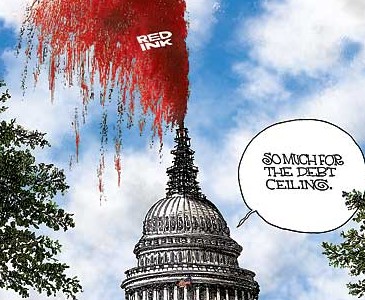
We've only to read the recent news reports about the debt ceiling deadline to see some clear examples. Most notably, for example, Eric Cantor who clearly used a premeditated speech act to oppose
"anything the 'Kenyan socialist' president might propose" were his words repeated in the Washington Post, June 28th by line of Katrina venden Heuvel. By referring to our President as a "Kenyan socialist", Mr. Cantor revealed that his clear purpose was not to engage in a debate about truth. The more bizarre, improbable and twisted the innuendo, the more likely that his meaning will be misappropriated.
If we take more time to compare the news reports of Congressional Republicans with those of Democrats and the President we'll clearly see that Republicans continually refer to increasing taxes or new taxes as a component of the democratic proposal when what is really being proposed and discussed is ending tax breaks for millionaires and billionaires. Those are not new techniques in the arsenal of political posturing. But what Americans hear is more taxes, more spending, again and again. Those are speech acts or linguistic tactics specifically intended to undermine truth in the debate.
John Boehner was quoted by the New York Times as saying,
"The American people know tax hikes destroy jobs." More speech act tactics which are not about making substantive claims. They are clearly intended to dramatize the debate and undermine the political discourse. Does John Boehner's statement really mean that ending tax breaks for oil and gas companies, hedge funds and closing corporate tax loopholes is going to put even more of us out of work and further fuel wage deflation?
Mitch McConnell in a speech Wednesday said,
"It's about whether Washington will ever be held accountable for its mistakes. That's why Republicans refuse to let the taxpayers take the hit when it comes to reducing the debt." Is there really truth in that debate? Which taxpayers is he really talking about--the corporations who will fund his campaign and those whose tax rate is lower than the guy outside mowing the lawn? Insincerity is another form of speech act. What Americans need to understand is that its true purpose serves solely to silence truth and the voices of reasoned debate.
If the President and Congressional Democrats are repeatedly called irresponsible by corporations who can spend any amount they want on electioneering propaganda coordinated in step with the likes of the House Speaker, House Majority Leader and Senate Minority Leader, then voters will be less willing to believe anything being said by the President or Congressional Democrats.
On the other hand, by trying to protect all federal spending except defense, Congressional Democrats are guaranteeing that many of their most important plans will be in jeopardy. Programs that award college scholarships, finance the National Weather Service and medical research, and improve food safety, for example.
The challenge for individual Americans over the months to follow is seeing through the deceptive agendas and the secretly financed campaign fronts whose funding comes by way of executive expropriation of corporate shareholders money that is being spent, usually without their consent, to make negative and false attacks and not to engage in honest political debate.
It surely is being argued and insisted that Democrats, too, are free to spend unlimited amounts in secretly funded campaign strategies and therefore elections are on a fair and level playing field. But the democratic system becomes far too weighted by the access to unfathomable corporate treasuries which Conservatives are able draw upon and the fact that progressives don't believe in clandestine campaign funding.
There is a mountain to be climbed which voters are unlikely to fully appreciate and which the President needed to make more clear, which is, that even in the financial straits in which the country currently finds itself, more help for the economy is still needed. Specifically, political support is needed to extend a reduction for payroll taxes and provide loans for infrastructure which has the benefit of providing an important exponential return benefit. The President's reminder that our economic recovery will take time doesn't fully drive home the fact that the broader measure of unemployment is almost 20 percent depending on which segment of the population or region of the country is measured.
The true measure of the success of the stimulus is not the actual level of unemployment, but what unemployment would have been without the stimulus. According to Nobel Prize winning economist, Joseph E. Stiglitz, all evidence showed that the stimulus had made things better. In his opinion, the benefits of the stimulus are so strong that it outweighs the longer-term risks of indebtedness increases and higher interest demands of creditors which is why the debt ceiling debate is such an irresponsible Republican ploy.
It becomes very hard to argue against the conclusion that Republicans have moved from merely rooting for a bad economy to actively committing to making it worse when one thinks carefully about how irresponsible the threat to blow up the economy over the debt limit truly is.
Try to think in these terms as you work through the bizarre political dialogue on the economy--if another round of stimulus money were spent on investments, those adverse effects of concern are less likely to occur because markets should realize that the United States is actually in a stronger economic position as a result of the additional stimulus, not a weaker position. If the stimulus spending is for investment, then the asset side of the nation's balance sheet increases in tandem with the liabilities and there is no reason for lenders to be worried, and no reason for an increase in interests rates.
The big issue raised last year by economist Joseph Stiglitz, who believed that the initial stimulus was insufficiently strong enough, was whether the government would continue to provide a stimulus should the economy fail to achieve a robust recovery after its first dose of medicine, as is the current state of our economy?
Americans need to add to their Christmas "wish list" a second dose of stimulus funding and open our eyes to the irresponsible partisan agenda of the deficit hawks in Congress urging a cutback in government spending until our economy returns to and maintains stronger growth. The interests and voices of the public must not fall silent to extremist ideology and a vengeful partisanship agenda. We can each remain true to our political affiliations, republicans and democrats alike, and fix what is wrong with our democracy by granting ourselves the grassroots support to make election reform and the changes needed part of our list of wishes for restored democracy.